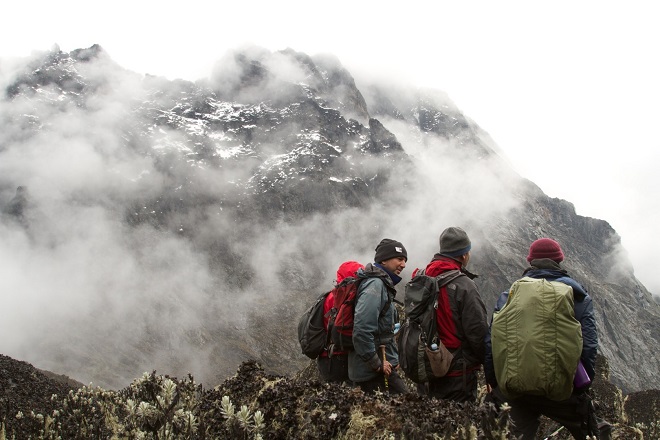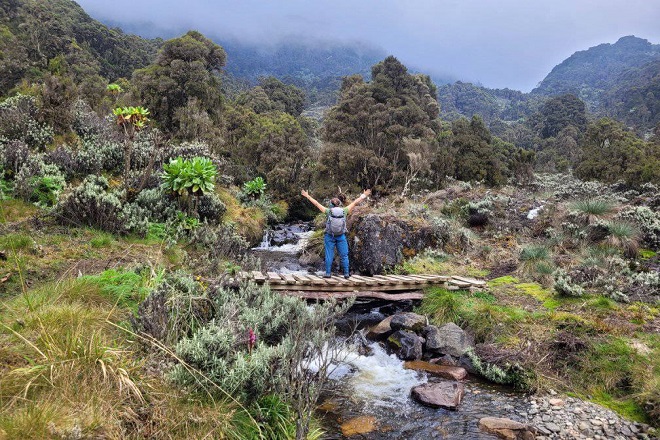
six major peaks of the Rwenzori Mountains
six major peaks of the Rwenzori mountains are the notable peaks that were formed as a result of faults in the rocks and existed about a million years ago that boasts the Mountains of the Moon. These peaks are situated on the Rwenzori Mountain ranges and they include; margherita peak (5109m), mount speke (4890m), mount Baker (4843m), mount Luigi di Savoia (4627m), mount Emin (4798m) and mount Gessi (4715m).
The Rwenzori mountains has about 25 historical peaks on the six major peaks or on the six Rwenzori Mountain ranges, Including the peaks that can not be climbed because of the physical terrain and global warming effects. These peaks used to be easily climbed when there were still adequate glaciers about 40 years ago.
The six major peaks of the Rwenzori mountains have other peaks that are climbed to date and others are shared by Uganda and congo. All the peaks are climbed from Uganda but not in congo because of the type of the terrain and security insurgencies in congo.
Other peaks that are not mentioned on the six major massifs are the portal peaks (4370m) that were discovered by the explorer sir Gerald portal. The peaks on top of the portal peaks includes; Cagni peak.
On each of the mountain massif, there are several peaks and they include the following;
- Mount Stanley, the peaks on Mount Stanley includes margherita peak (5109m), Alexandria (5091m), Albert (5101m), Elena (4967m), Great Tooth (4953m), Savoia (4977m), Elizabeth (4928), Philip (4919m), kitasamba (4862m) and nyabibuya (4862m)
- Mount speke, the peaks on mount speke includes Vittorio Emmanuele (4890m) Ensonga (4865m) and Johnston (4834m)
- Mount Baker, the peaks on mount baker includes Edward (4843m), semper (4795m), Grauer rock (4484m), Moore (4624m) and Wollaston (4627m)
- Mount Luigi di Savoia, the peaks on mount Luigi di Savoia includes Weismann (4620m), Sella (4626m) and stairs (4545m)
- Mount Emin, the peaks on mount Emin includes, Umberto (4798m) and Kraepelin (4791m)
- Mount Gessi, the peaks on mount Gessi includes Lolanda (4715m) and Bottego (4699m)
Margherita peak 5109m is the highest peak in Uganda and the third highest mountain on the African continent that makes the Rwenzori mountains a mountaineering destination.
Best time to visit the six major peaks of the Rwenzori mountains.
The six major peaks of the Rwenzori mountains can be visited all year around, but the best months that gives clear skies are between December to February and June to august.
How to book climbing the six major peaks of the Rwenzori mountains.
Always book with the Rwenzori Mountain experts like us and we guide you on the best recommended and suitable itinerary for you to conquer the six major peaks of the Rwenzori mountains.
Tips for climbing six major peaks of the Rwenzori mountains.
- After booking to climb the six major peaks of the Rwenzori mountains, prepare mentally and emotionally not forgetting time management in order to conquer these peaks.
- Prepare your body by climbing other small mountains, running, or visiting the gym before you embark on the journey to the Rwenzori mountains.
- Take adequate water when hiking to stay hydrated.
- Take regular stop overs to eat your parked snacks to add more extra energy to push you.
Vegetation zones along the six major peaks of the Rwenzori mountains.
The Rwenzori mountains have got five vegetation zones that includes the montane forest zone, the bamboo zone, the heather zone, the afro alpine zone and the rocky/glacier zone.
Trails that access the six major peaks of the Rwenzori mountains.
The Rwenzori mountains have got three major trekking trails that includes the central circuit trail, the bukurungu wilderness camping trail and the kilembe trail.
Trekking gear required to climb six major peaks of the Rwenzori mountains.
- Crampons
- Harness
- Sleeping bags
- Rubber boots
- Headlamps
- Snow glasses
- Snow gloves
- Ice axe
- Rope
- Helmets
- Hiking boots
- Trekking poles
- Warm jackets
- Poncho/rain jacket
Detailed itinerary to the six major peaks of Rwenzori mountains.
Day 1: Nyakalengijo (1651m) to Nyabithaba Hut (2651m).
The Rwenzori hiking starts at the Rwenzori mountains national park Mihunga gate 1651m asl.
The driver guide will drive you to mihunga gate for briefing, meeting porters, chef and the guides. The trail begins passing through farmland to the park boundary beyond which it follows a thick forest along the mubuku river. Cross the mahoma river tributary before starting a long steep climb up onto a massive ridge to reach Nyabithaba hut.
During this part of the trail, you may hear chimpanzee and see black and white colobus monkeys, blue monkey and the brilliantly coloured Rwenzori turaco.
Day 2: Nyabithaba Hut to John Matte Hut (3505m).
On your day 2 of the Rwenzori trekking Safari, you will begin climbing to John Matte Hut after your breakfast. this is believed to be the longest trials as it consumes minimum of seven hours on move.it involves passing through the forest for a short time before you cross Kurt Schefer bridge on river Bujuku. From here the trail to Nyamuleju Hut is very smooth and clear as it takes few hours although as you go far, the trail becomes more steeper as your entering higher grounds which is the place common for heather plants. you will proceed with the trail through massive heather forest and from the trail along River Bujuku, this will take roughly 3 hours and a distance of 200m to reach John Matte hut.
Day 3: from johnmaate hut to skull cave rock shelter and Rocket pass.
In the morning, the trail takes you through the heather forest and join the tussocks vegetation on the flat section and reach covering about 6 to 7 hours.
Day 4: Rocket pass to Lac de Laluna, ascending mount Gessi via lolanda.
Early in the morning after breakfast, you proceed through the vast vegetation leading us to mount Gessi and back for a night.
Day 5: Rocket pass and Lac de Laluna to climb mount Emin.
Early in the morning, pass through the stunning scenery ideal for wildlife where you cross path with red Rwenzori duikers and rock hyrax before you climb sharply onto the exposed cliffs of mount Emin and after the summit get back to lac de laluna camp for dinner and overnight.
Day 6: Lac de Laluna to Bigo camp
After breakfast, you set off to bigo camp which is more of descending with views of mount baker, mount speke and Mount Stanley. It takes about 8-9 hours to arrive at bigo camp.
Day 7: Trek from Bigo camp to Bujuku Hut (3,962m).
After break fast in the morning, you start from bigo camp to Bujuku hut. The trail leads up to cross the Bujuku River and arrive at omwihembe resting point, then join the board walk passing by the bujuku lake and reach bujuku hut.
Day 8: From Bujuku Hut to mount speke 4890m
After an early morning breakfast, you set off to climb mount speke, pass near the Stulhmann pass and join the alpine rocky section and through boulders viewing parts of Congo side and reach mount speke, after reaching the peak and taking photos return back to bujuku hut for overnight.
Day 9: from Bujuku hut to Elena hut (4541m)
On this day, you trek through the groundsel vegetation along the 4km path, climbing up 4541m which is about 5-7 hours hike. You will ascend through the sides of the Upper Bigo bog, and later on follow the hike down through the steep slopes of Lake Bujuku to the West. Climb up to the 4372m Scott-Elliot pass, and later continue through several swamps and the remarkable ground gully. You will then walk through the steep section above the gully by a metal ladder reaching a junction with two divided trails, with the right trail leading to the Elena Hut rising through a steep trail above the large boulders to Mount Stanley while the left trail heads to the Scott-Elliot pass descending to Kitandara hut.
The trail is then divided into two. The two trails, the left trail leads to Scott-Elliot pass descending to Kitandara Lakes while the right trail heads to the Elena Hut and on a steep trail above large boulders to Mount Stanley. Situated at the rocky part of Mount Stanley, Elena hut is located in a cold region, although it offers beautiful views of Mount Baker and Mount Speke, which is sometimes hard to see due to fog. Dinner and an overnight at the Elena hut.
Day 10: From Elena to Margherita to Kitandara
Today, you will wake up as early as 2:00am, for breakfast, and embark on your hike to the top of Margherita peak, taking about 4-5 hours. You will hike through the Stanley plateau to Mount Stanley. Using ropes, you will hike through the sharp rocky regions, while the crampons as well as the ice axe will be used on the glacial axe- as directed by the guide. This will take a couple of hours, after which you will reach at the edge of Margherita glacier-the most challenging part of the 7 days Rwenzori trekking Safari. You will then proceed to the top of the peak of Mount Stanley (Margherita Peak-at 5109m).
At this point, enjoy the impressive views of Lake Ireen, Mount Speke and the surrounding, after then descend Elena hut for lunch and dinner.
Otherwise, you can proceed to Kitandara, through the Scott Elliot pass (also considered as the most beautiful spot of Rwenzori) dinner and an overnight at Kitandara hut.
Note That: However, depending on your group’s strength, you may opt to spend another night at Elena Hut, and continue the next day to Kitandara then to Guy Yeoman.
Day 11: Kitandara hut 4023m to mount baker Guy Yeoman Hut (3505
After breakfast, a sheer hike from the base of Mt Baker to the fresh field pass south parts of Rwenzori over the distance of 4280m. Outlook the Congo in the west and Mt Stanley in the north is very possible. From the trail, the boggy pass proceeds downhill, going through the rock housing at Bujongolo which is a historical excursion by the Duke of Abruzzi in 1906.
Day 12: From Guy Yeoman Hut to Nyakalengijo.
After your morning breakfast, you will start descending back to Nyabithaba Hut; this will take around six hours depending on the pace to reach the Hut. The trek goes past the nearby Lake Mahoma and Nyabithaba and passes through the heather area and the Moss Zone. This is the final day in the Rwenzori Mountains. Overnight in Kasese.
If you are planning an attempt to climb the six major peaks of the Rwenzori mountains, make sure you book 12 to 14 days for more acclimatization and conquering all the peaks.

Recent Posts
Trekking Rwenzori Mountains from Germany
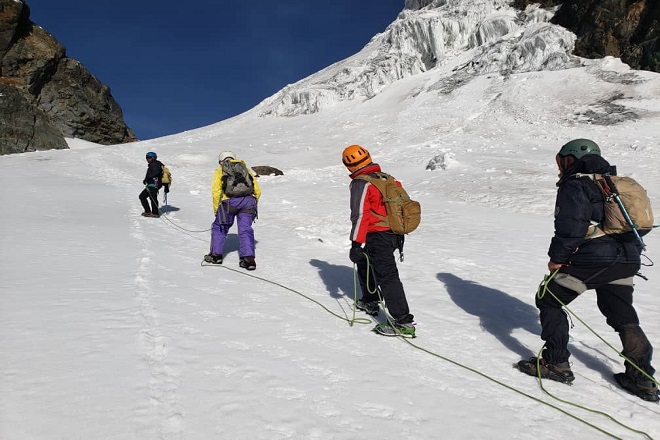
Hiking the Rwenzori Mountains