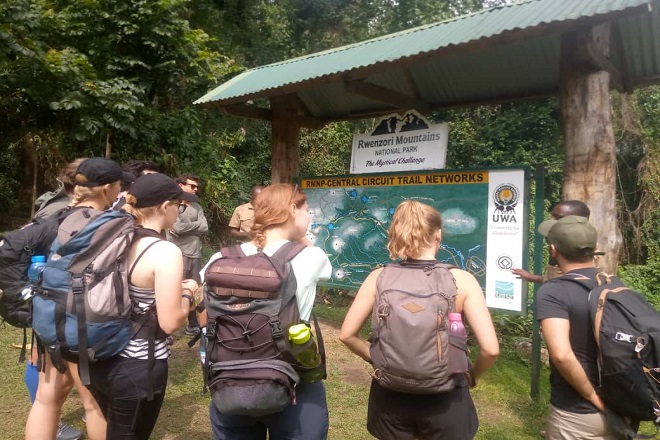
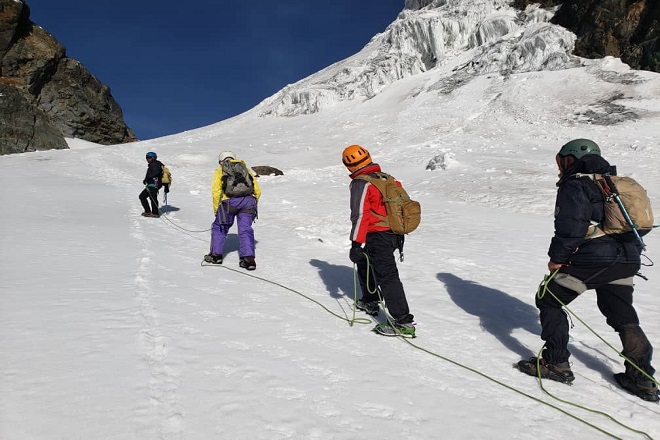
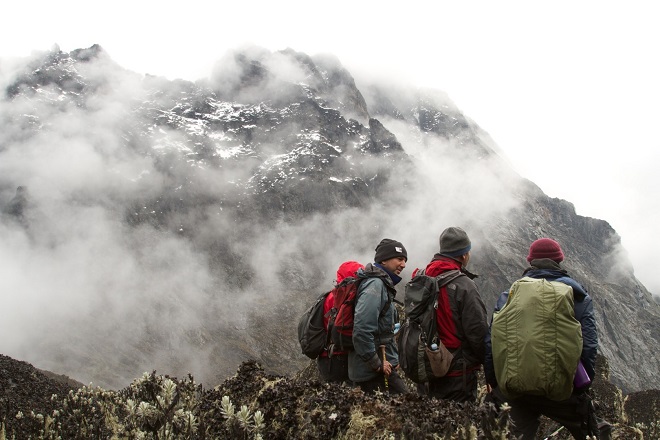
Backpacking in Rwenzori mountains is possible when arranged with your tour operator. Rwenzori mountains host back packers that want low costs of travelling. We create the best itineraries for back packers intending to hike the Rwenzori mountains anytime of the year.
Backpacking in Rwenzori mountains is recommended and planned with us, but the mountain demands physical fitness and when you want to carry everything at your own, you are almost likely not to make it.

Backpacking in Rwenzori mountains.
What to carry during backpacking in Rwenzori mountains.
List of items to pack during backpacking in Rwenzori mountains
- Rubber boots
- Hiking shoes
- Headlamps
- Matchbox
- Pocket knife
- First Aid kit
- Air pads
- Sun protection
- Rain gear
- Bandana
- Trekking poles
- Binoculars
- Water bottle.
Backpacking in Rwenzori mountains requires a guide to show you the trails, guiding you on the safety in the mountains. a cook is needed to prepare your meals for a successful trip and porters are also needed to carry your meals, gear and cooking gas. Depending on the Rwenzori trail used, one of the important items to carry is a tent and a warm sleeping bag.
Rwenzori mountains trail best for backpacking
Bukurungu trail: this trail is best for camping in the Rwenzori mountains and for low-cost travelers/backpackers intending to explore the Rwenzori and climbing margherita peak.
Mahoma loop trail: the Mahoma loop trail is considered a camping trail for backpackers that explores the Rwenzori mountains in a short period of time. Other Rwenzori trails include central circuit trail and the kilembe trail.
Note: on the kilembe trail, camping is not recommended.
Best time for backpacking in Rwenzori mountains.
In Rwenzori mountains you can start your backpacking adventure at any time of the year but the best period is during the dry season between the months of December to January and June to August where by during this period the mountain receives less rains making the trails passable. The Rwenzori Mountain is a rainmaker and always predictable.
What to see when backpacking in Rwenzori mountains.
Rwenzori mountains have got over 217 bird species and 70 mammal species not forgetting the rare three horned chameleon. You will see different bird species like the Rwenzori turaco, white browed robin chat, Red chested cuckoo, malachite sunbirds, African paradise flycatcher and more birds.
You will encounter animals like the colobus monkeys, blue monkeys, Rwenzori duikers, Rock hyrax, chimpanzees and many more. Rwenzori is another place where to spot different plant species like the dendrosenecio plant, lobelias, Mildred Lilies, crotalaria, orchids and many more plants.
Where to stay
On your trip to the Rwenzori mountains, there are low costs accommodations for backpackers where to sleep before the hike. They include Ruboni community camp, Ribona guest house, white house, imperial hotel, Kamwe kamwe hotel, Bwiranda hotel and many more.
If you plan to camp along the trail, bring your camping equipment or rent it locally. Camping in designated campsites is often more budget-friendly than staying in or huts.
How to reach Kasese
You can travel to Rwenzori mountains in Kasese by taking a bus or a private taxi from Kampala to Kasese and head the bukurungu trail starting point.
Detailed itinerary to Bukurungu trail for backpackers.
DAY1: KASESE TOWN – KASANZI CAMP (2650M).
Have an early morning breakfast before checking out of your hotel for transfer to Omukorukumi before hiking through the community of Kasanzi starting off your trek before you enter the Rwenzori mountains national park through the Bukurungu wilderness camping trail.
You will meet your porters and have an interaction as you give away your backpack for carrying.
Proceed hiking with some resting points along the community trail before entering the park to arrive at Kasanzi camp 1km into the tropical forest for a rest.
The climb from Omukorukumi to Kasanzi camp takes 4-6 hours.
DAY 2: KASANZI CAMP – KAMBEHO CAMP (3290M)
After a hot breakfast depart for Kambeho camp (Kambeho means a place of coldness in Lhukonzo) also locally known as Lhume camp named after River Lhume.
Getting to this camp takes you through the heather trees (Ericathiasis) with lots of moss hanging – over these trees like the old man beard.
Kambeho camp lies in the heather zone which is characterized by views of hanging valleys and it is through the same zone where both varieties of monkeys can be met- The black colobus monkeys, Black and white, and Vervet monkeys. It is the zone of the Rwenzori Turaco, a rare beautiful bird in the park
Arrive at Kambeho camp in the late afternoon for hot drink, dinner and an overnight.
DAY 3: KAMBEHO CAMP 3290M TO BIGO CAMP.
Early morning leave Kambeho camp after a somewhat cold night climbing along River Lhume taking the Mughuli pass the only steep bypass on the trail.
After a steep climb on Mughuli bypass descend down past Lake Mughuli which is within a strong MTN network service to allow you catch up with some mobile phone calls before proceeding to Lamia camp for lunch. then after proceed to bigo camp.
There are several unnamed beautiful peaks which can easily be climbed by those interested as they acclimatize for climbing the Portal peaks and Mount Gessi. Around the camp, you can easily explore the water falls which gives the real taste of the Rwenzori mountains waters.
Overnight at bigo camp.
Time duration:8-9 hours
DAY: 4 BIGO CAMP TO BUJUKU CAMP 3962M
After breakfast in the morning, ascend through the heather trees forest to cross the upper bigo bog board walk and cross river bujuku, ascend to omwihembe resting point then about 4 minutes join a board walk on the bujuku lake and reach bujuku hut for overnight.
Duration: 4-5 hours.
DAY 5: bujuku CAMP – to MARGHERITA PEAK and back to BIGO CAMP 3,500m asl
Have an early morning breakfast and start trekking up to summit Margherita peak, have a photo moment to celebrate and keep memories of reaching the highest point in Uganda.
Return to bigo Camp for an overnight.
Duration: 7-8 hours
DAY 6: BIGO CAMP – MIHUNGA GATE (1651M) – KASESE TOWN.
After an early morning breakfast, you start a descend down to the mihunga gate through Johnmaate camp cross the bujuku river and join boardwalks taking you through the heather trees forest and cross river mubuku on kurt schifar bridge and reach Nyabithaba hut for a hot lunch then start descending to the gate and sign out of the park.
Descend duration: 7-8 hours.