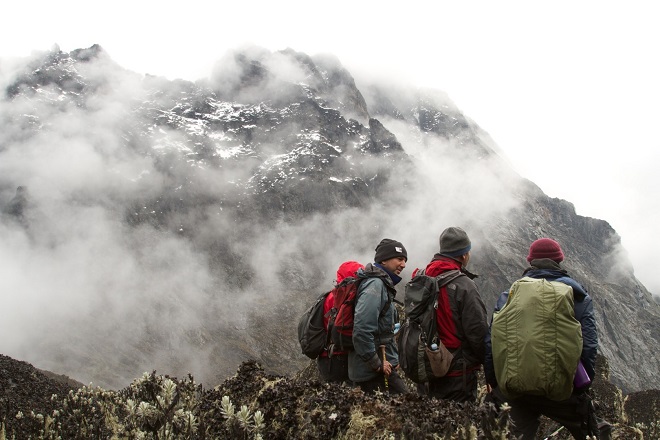
Hiking the Rwenzori mountains, The Rwenzori Mountains, often called the “Mountains of the Moon,” rise majestically in western Uganda along the Uganda-DR Congo border. This 996km2 mountain range is home to some of the most breathtaking and diverse landscapes in Africa, from equatorial snow-capped peaks to lush montane forests and moorlands.
The park was gazetted in 1991, declared a UNESCO World Heritage Site in 1994, and later designated a Ramsar Wetland of International Importance in 2008, highlighting its global ecological significance.
The Roof of Uganda; Margherita Peak (5,109m)
The highest point of the Rwenzori Mountains is Margherita Peak (5,109m) on Mount Stanley, making it Africa’s third-highest peak. Unlike East Africa’s volcanic giants such as Kilimanjaro and Mount Elgon, the Rwenzoris were formed by tectonic activity, with massive rock blocks thrust upward from the Western Rift Valley floor.
The Rwenzoris were first documented by the Alexandrine geographer Ptolemy in AD 150, who referred to them as the “Mountains of the Moon,” believing them to be the source of the Nile River. Later, on May 24, 1888, the explorer Henry Stanley officially placed the Rwenzoris on the world map, recording the name “Ruwenzori,” which he documented as meaning “Rain-Maker” or “Cloud-King” in the local language.
A Landscape Like No Other

Hiking the Rwenzori Mountains
The Rwenzoris are a mystical wonderland, with their lower slopes covered in rich montane forests, bamboo woodlands, and vast moorlands. As altitude increases, the landscape transforms into an otherworldly botanical paradise, where giant lobelias, tree heathers, and “everlasting flowers” thrive among moss-draped rocks, creating a scene that feels almost magical.
The park protects the highest parts of the Rwenzori range, sheltering over 70 mammal species and 217 bird species, including 19 Albertine Rift endemics and some of the world’s rarest vegetation. The diverse ecosystems make it an important conservation area and a haven for biodiversity.
How to get to Rwenzori mountains/hiking the Rwenzori mountains
Rwenzori mountain can be accessed by Road transport or Air transport, from Entebbe international Airport or from Kigali international Airport. By Road transport from Entebbe via Fort portal-Kasese route or Mbarara-Kasese route and by Road transport from Kigali international Airport to katuna border Kabale-ishaka-Kasese.
To access Rwenzori Mountain by Air Transport from Entebbe international airport, you book through Aero link for a flight to Kasese Airstrip and proceed to the park gate by vehicle which is a faster way to Reach the Rwenzori.
Rwenzori mountain access gates are mainly three, namely Mihunga central circuit trail, Kilembe Trail and Bukurungu wilderness camping Trail. These routes will lead you to margherita peak 5109m.
When is the best time for hiking the Rwenzori Mountains
The best time for hiking the Rwenzori mountains, starts in the months of December to February and June to August where by during this time of the year the trails are dry and easier to trek. However, the Rwenzori mountains is trekked all year round.
What to pack for hiking the Rwenzori Mountains
When planning to have Rwenzori mountains on your bucket list, these are the following items to have on your trip to the Rwenzori mountains.
Crampons
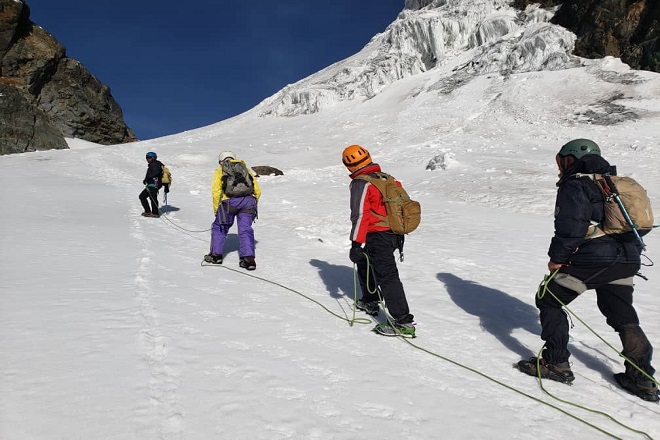
Crampons are so important, they help to climb through the glaciers as they make step into the glacier.
Harness
in order to use fixed ropes along the trail, you need to put on a harness that improves safety when ascending and descending on the steep rocks.
Rope
A rope helps so much when abseiling down on steep rocks and roping up a guide with clients when crossing crevasse and slippery ice sections.
Ice axe
An ice axe helps climbers to move firmly when crossing ice sections and it helps to make steps on the glaciers.
Waterproof gloves
Do not forget to carry gloves because of the unpredictable weather conditions of the Rwenzori Mountain they help protecting the hands from cold conditions.
Sleeping bags
A sleeping bag is a must when attempting a climb to the Rwenzori mountains, consider a sleeping bag with room temperatures -15F to out compete the cold temperatures of the Rwenzori mountains.
First Aid Kit
A first aid kit is essential for every mountaineering adventure, the kit should have energy, stomach and headache tablets, deep heat, painkillers etc.
Hiking boots
Hiking boots should be waterproofs with steady grips to avoid slipping on the ground.
Helmet
This helps to keep the head warmer when going to the peaks as well as for safety while crossing on the rocks.
Ascenders
An easy way to ascend on the fixed ropes is to use ascenders/jumaring as it gives climbers more confidence and safety.
Gaiters
These helps to prevent water from entering the shoes in case of rain.
Trekking poles
The trekking poles helps you to balance and adding more energy to push yourself especially when going uphills.
Water proof pants
When putting on waterproof pants, you are sure of not getting too wet when it rains.
Rwenzori Mountain Ranges to Conquer
Rwenzori mountains consist of several historical massifs that includes Mount Stanley, mount speke, mount baker, mount Gessi, mount Emin and mount Luigi di Savoia. Mount Stanley hosts the highest peak (margherita peak 5,109m) that was named after the Queen Margherita of Italy.
Places to stay/accommodation
There are a variety of accommodations where to stay before and after the Rwenzori mountains hiking tour that ranges from budget, moderate and luxury stay. These includes; Ruboni community camp, snow heights lodge, sandton hotel, Ngabu hotel, margherita hotel, kanamba invent hotel, imperial hotel and many more.
For all Rwenzori mountains Expeditions we lead you to a successful Adventure.