

Kororo falls
The Kororo falls are a serie of beautiful waterfalls located at the foothills of the Rwenzori mountains at the edge of the Rwenzori mountains national park in Kanyatsi village, Kyondo Subcounty, Kasese district. A visit to Kororo falls offers a spectacular trekking experience through the community with cultural performances, a community visit and local meal.
Kororo falls are a 1.5 hours drive from Kasese town and Queen Elizabeth national park along the Kasese-Kikorongo-Mpondwe highway.
Located at the confluence of the Kabiri and Kithangetse rivers in Kyondo sub-county, Kasese district in the Muyina chiefdom of the Obusinga Bwa Rwenzururu.
What to know about Kororo falls
Kororo falls are named after an obstinate man who once lived in the area.
Legend has it that when Kororo’s brother, mwithangetse brewed banana beer, a scuffle ensued, with Kororo claiming the brew. They were advised to share it but Kororo refused. To settle the matter, a ritual had to be performed where both parties were made to go through an arc-like structure made of omuramura grass (dracaena). Kororo was found guilty; he collapsed after going through the arc and staggered to the waterfall to drink but drowned instead.
Since then, the site with its twin waterfalls has become significant for conflict resolution, the dispensation of blessings and for healing. Omuramura means which ‘judges’; in the past, if one of the parties went through the arc and fell, followed by an owl’s hooting, they were presumed guilty, pushed down the steep hillside onto the stones leading to the falls and left to drown.
Until recently, whenever there was conflict in the community- a land wrangle for example; the concerned parties would be brought to the site and a ritual performed by the spiritual leaders to determine right and wrong. The first wife of the ridge or spiritual leader (Nyabalimu – the mother of the family’s gods) would prepare the first meal for those going for the ritual. Chicken or a goat were slaughtered, as instructed by the gods. Pieces of meat were placed for them on banana leaves (esyondekere) in the shrines. Musical instruments such as the drum (engoma), ankle bells (esyonzenda), shakers (Obuyanda), Xylophones (Esyondara) were played while singing to evoke Kororo’s and the ancestor’s spirits.
Every ritual had its own song. Both parties would make vows: “If I am not the rightful owner of ….(the item) we are fighting for, let the waters of this waterfall judge me wrong.”
The ritual acted as a powerful deterrent for those predisposed to telling lies, stealing or starting senseless fights over property. Whenever there was a conflict, the warning parties easily told the truth for fear of being taken to Kororo.
During the colonial period, however, the Kororo conflict resolution system ended but the community continues to visit the site for spiritual consultations.
Ekisalhalha kya Kororo (Kororo waterfall) is affected by climate change: recent floods washed away one of the shrines and the god evoking instruments it contained.
There is a need to increase the vegetation cover around the site to mitigate the effect of climate change. The community’s future plans include the erection of an information board, training their members as cultural tourism guides and establishing an Ekyaghanda ky’ebitswero (cultural museum).
Conservation
Conservation efforts around Kororo falls are managed by Kyondo Community Conservation and Tourist Association (KCCTA) a community organization of the people surrounding the waterfall.
The community land in the area has been gazetted for tree planting and bee keeping to restore the vegetation cover and preserve the rich cultural heritage of the area.
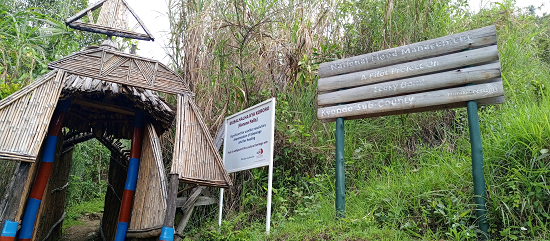
The community efforts are being supplemented by various stakeholders such as the Cross Cultural Foundation of Uganda (CCFU) which helped in organizing the area as well as publishing and documenting its cultural history.
Tourism
The Uganda Wildlife Authority through Rwenzori Mountains national park is working with the community to open up a community Rwenzori mountains trekking trail to Margherita peak from the area where there was allegedly a hiking trail to Margherita peak in the past.
The community claims there existed the Kyalhumba-Kyondo hiking trail through the Rwenzori mountains to Margerita peak. This Rwenzori mountains hiking trail used to move along River Nyamugasani into the Rwenzori mountains to Margherita Peak 5,109m asl.
The tourism trail reportedly existed before the Rwenzori Mountains national park was gazetted as a conservation area in 1991. According to the reports, the abandoned trail used to have four temporally tourist camps namely Mbulhamasi, Kasusuthi, Musalombi and Bwikaraghe. Mbulhamasi was reportedly near Margherita peak on Mount Stanley. This would give an opportunity to summit any of the major peaks in the Rwenzori mountains ranges including Mount Speke, Mount Baker, Weismann’s peaks, Albert peak, Mount Gessi, Mount Emin and the Portal peaks.
A one day visit to Kororo falls can be organized by your Rwenzori hiking tour operator any day starting from around Kasese town or Queen Elizabeth national park. A visit to Kororo falls is one of the best experiences to enjoy in the Rwenzori mountains national park.
For the best experience at Kororo waterfalls, it is advisable to book in advance a day before your trip to Kororo falls.