

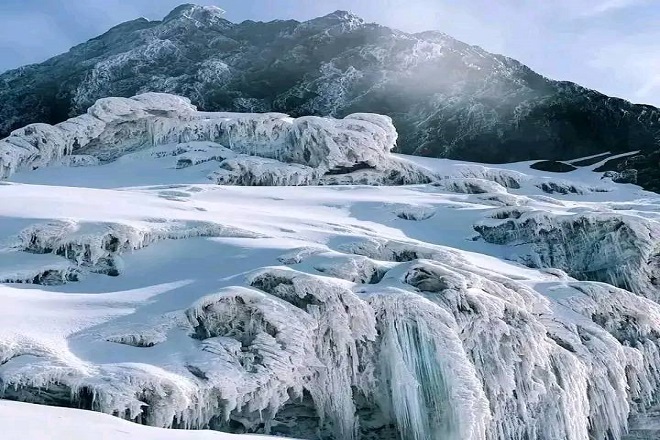
Rwenzori mountains Glaciers.
Rwenzori mountain Glaciers offer an amazing encounter during your Rwenzori mountains trekking expeditions. Rwenzori mountain glaciers have been in existence since the formation of the mountain three million years ago until it started receding due to climate factors that occur seasonally.
Rwenzori mountains are the only mountain in Uganda that has glaciers and holds the second largest glaciers after Mount Kilimanjaro and Mount Kenya on the African continent.
During the wet season of the year, the mountains receives more cold temperatures and sometimes the Rwenzori mountains receives snow on mount speke, mount Baker and Stanley. in scientific observations the glaciers shrink during hot conditions and glaciers grow in cold conditions.
Rwenzori mountain glaciers formation
Rwenzori mountains is a block mountain that was formed by natural faults in the earth’s crust. Rwenzori mountains cover an area of 996km2 along the Uganda and Democratic Republic of congo
Rwenzori mountains Glaciers in Uganda.
There are still glaciers in Uganda and specifically in the Rwenzori mountains highest points on mount baker, speke, Elena, Stanley plateau and margherita. Though the Rwenzori mountains experience little glaciers seasonally, the Rwenzori mountains Glaciers started receding rapidly because of the global warming experienced around the world.
Glaciers are a vital source of water for many lakes and rivers flowing on the slopes of the mountains and the Rwenzori Mountain holds a cultural norm to the native bakonzo people staying at its foothills.
Glaciers of the Rwenzori
- Mount speke glacier
- Mount Baker glacier
- Elena glacier
- Stanley glacier
Historical back ground of Rwenzori Mountain glaciers
Rwenzori mountain glaciers in Uganda, are a 120-km-wide horst that straddles the Uganda and DRC border that trends northwestward from the Equator for approximately 100 km. Subaerial erosion has carved out a network of deep valleys and individual mountains. Within the central area of the range, 25 peaks rise above 4,500 m, and the highest point is the Margherita peak on Mount Stanley, which is one of six mountains with a cover of glacier ice. The Rwenzori may be the mythical snow-covered Lunae Montes where Aeschylus, Ptolemy, and Aristotle believed the Nile had its source (Filippi, 1909). Over the centuries, the mountains continued to be written about, appeared on maps, and were still being sought by 19th century explorers (Jeannel, 1950). The Rwenzori may have been seen by Europeans as early as 1864, although it is generally agreed that Stanley was first to glimpse their snow-capped peaks in 1888 (Abruzzi, 1907). Photographs of the snow-covered western slopes taken in 1891 clearly depict glaciers that were not recognized (Stulhmann, 1894), and the existence of glaciers was not documented until 1900 (Moore, 1901). Scientific work was subsequently initiated by the Duke of Abruzzi, whose 1906 expedition identified 30 glaciers and named 20 of them (Abruzzi, 1907; Filippi, 1909). No further investigation of the glaciers was made until the detailed survey of the Speke Glacier in 1949 (Menzies, 1951a,b). A series of small studies followed, which culminated in six expeditions mounted between 1958 and 1961 (Whittow 1959; Whittow and Shepherd, 1959; Osmaston 1961; and Whittow and others, 1963). By 1958, the 37 surviving glaciers had been seen, although some remained unnamed and unvisited. Observation of four of the main glaciers continued until 1967 (Temple, 1968); since that time there has been no substantial scientific work.
A 1:50,000-scale map of the peaks, passes, and glaciers of the Rwenzori was produced during the 1906 expedition (Abruzzi, 1907); magnificent photographic panoramas of the peaks and glaciers were incorporated into the more detailed account of Filippi (1909). Busk (1954) discussed discrepancies between the photographs and the 1906 map. Stump (1952) produced a 1:25,000-scale map of the central peaks based on a 1937-38 terrestrial photogrammetric survey, but this Deutscher Alpenverein expedition excluded the glaciers on the congo side of the range. In 1958, a 1:50,000-scale map was published; this was followed in 1962 by a 1:25,000-scale map (reprinted 1970) of the central Rwenzori that incorporated glaciological detail from the 1958-61 expeditions. Osmaston and Pasteur (1972) published sketch maps of the peaks. Livingstone (1962, 1967) suggested that the most recent deglaciation of the Rwenzori began 14,700±290 years B.P., on the basis of a C14 date obtained for basal sediments extracted from a kettle lake lying inside massive moraines about 10 km from the contemporary glaciers on Mount Baker. The glaciers, which Nilsson (1931) estimated had locally extended across at least 100 km², have now retreated vertically through 2,400 m from these moraines (Livingstone, 1975). The Rwenzori are by far the cloudiest and wettest of all east African mountains. Precipitation is common all year round, with maxima around March-May and September-October. At about 4,300 m, a net accumulation of snow has been reported for these wetter times of the year. Maximum ablation occurs in January-February and June-August (Bergstrom, 1953; Temple, 1968). Livingstone (1967) believes that the western slopes of the Ruwenzori are wetter, but there is little observational evidence on the precipitation distribution in the peak regions; for the eastern slopes, the following annual precipitation totals are given: 1,140 mm at 1,220 m, 2,280 mm at 1,830 m, 2,540 mm at 3,050 m, and above that level values ranging between 1,910 and 2,790 mm. An altitudinal belt of maximum precipitation and daily circulation patterns, if existing at all, is certainly less well developed than on Kilimanjaro and Mount Kenya.
The persistent cloud cover must be regarded as a major factor in controlling the diurnal heat budget and hence mountain-valley wind systems. It is interesting that east-west asymmetries in ice extent are less well developed than on Kilimanjaro and Mount Kenya. A further feature of this perennially wet environment is the proximity of glaciers and lush vegetation on the Rwenzori, compared with Kilimanjaro, where a wide belt having a desertic appearance separates the dense tropical rain forest from the realm of perennial ice. The abundant precipitation and considerable cloud protection are conducive to the development and survival of glaciers on the Rwenzori. The atmospheric conditions have also prevented, although many of the glaciers that existed on the six glacierized mountain massifs of the Rwenzori had dimensions large enough to be discerned on Landsat images. In 1906, the glaciers were retreating rapidly from adjacent moraines (Abruzzi, 1907; Filippi 1909). Despite unabated 20th century wastage, the glaciers were considered by Spink (1949) to be in a healthier state than those on Mount Kenya and Kilimanjaro. This was confirmed by the glaciologist Bergstrom, who suggested that the loss of glacier ice had not been as catastrophic as had been commonly portrayed. Whittow and others (1963) estimated that the glacier cover was approximately 5 km², with 2 km² on Mount Stanley, 1.62 km² on Mount Speke, 0.67 km² on Mount Baker, 0.25 km² on Mount Gessi, 0.08 km² on Mount Emin, and 0.04 km² on Mount Luigi di Savoia.
We are the Best Rwenzori mountains hiking, trekking and climbing Experts.

Recent Posts
Mount Emin Climbing|Rwenzori Mountains

Rwenzori Mountain National Park
